Showing posts with label flight of friendship. Show all posts

Wednesday, July 27, 2011

Rikuzentakata - Guest Blog Entry

Blogger's Note: In an effort to capture as many perspectives of the experience as possible I have asked friends and colleagues from the trip to offer a narrative of their own experience.  While I might have pared down the narrative a bit in places, what you read next are the words, the thoughts, the memories of others who I worked with, rode with, sang with, side by side.  My personal thanks to those who took the time to share.  Sean
THE FOLLOWING ARE THE WORDS AND THOUGHTS OF MR. JOHN BAUMGARDNER:
We were going to Kesennuma. I was originally scheduled to work in Kessenuma, but switched to the second group which was going to be at a school in another town.  I had switched because I was trying to deliver some letters written by kids in the Elementary portion of our Japanese Immersion Program to kids who were still in shelters.  I am very glad I switched as the experiences I had with them would have a huge impact on me.
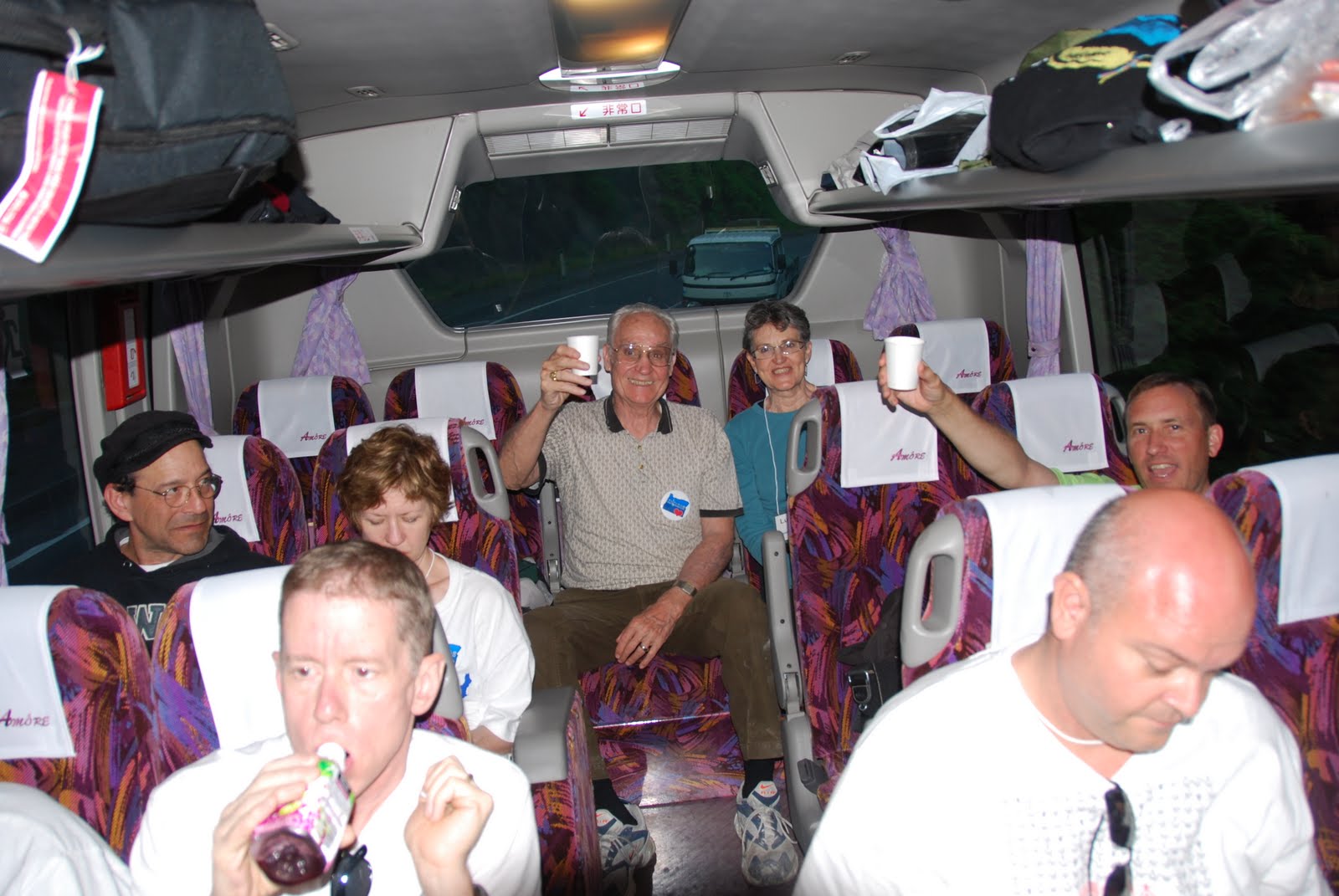
After dropping off the first group in Kessenuma (がんばって!), we continued on to the town of Rikuzentakata.   We left Kesennuma and continued to see the same kind of damage we had seen earlier that day and the day before.  After winding through the beautiful scenery of this area, the road dropped back down onto the coastal area and things started to feel different.  All my colleagues could feel that something was different because the bus got steadily quieter and slowly I began to realize that it was because the devastation here was complete. 
There was nothing left.  You could see the roads and where the neighborhoods were, but there were no buildings at all, just debris or in many places just emptiness.  As we wound our way through what was once Rikuzentakata (population 25,000) we took in the view - a beautiful bay surrounded by sheer devastation.  We drove mile after mile without seeing a single building.  During the quiet bus ride we noticed a lone tall pine tree where once a famous forest of 70,000 pine trees once stood - and the one surviving tree was in danger from the salinity of the salt water from the tsunami. 

We arrived at a Junior High School where our moods picked up.  Some of the town had indeed survived on a small hill that overlooked the bay.  As the bus pulled in, there were adults lined up for what we learned was “free shopping”.  A clothing company (we think it was Uniclo) had donated lots of clothes and people could come and select what they wanted.  While we waited for Peace Winds to arrive, Koh and I started walking around.  We would go up to people who were living there at the shelter and temporary housing units and Koh (日本人) would introduce us and start talking to them.  I don’t know much but simply by watching the interaction I could understand what was going on.  The caring and compassion that we shared seemed to make a small, but very real, difference in their difficult lives.  We would go from person to person and talk with them and then she would let me know what gifts I should pull from my backpack to give to them.  I reflected back on the briefing we had received at our reception with the US Ambassador, that we may think our job here was to clean or to hand out stuff at shelters, but our real job was to listen to the people if the opportunity came up. In this moment I felt so very privileged to be a part of all this and especially to be a witness to and a small part of such touching exchanges between people.
After a while it was the kids’ turn for “free shopping” and we watched as they selected new clothes to wear.  The Principal of the school came out as well and Koh talked to him and introduced us.  I presented to him some letters from our kids and a book on Oregon.  The kids quickly started passing the book around and looking through it.  After a nice chat, the Peace Winds people arrived and we started to finally get to work and the task we had come to do.
On some flat land at the Junior High a joint project between Mercy Corps and Peace Winds had built almost 100 temporary housing units and were busy building about 75 more.  There were about 20 or so that were already fully furnished and people had already moved into them.  Our job was to finish the process of furnishing the rest of the units so that more people could move in soon.  We worked very quickly giving each unit the correct number of futons, sets of sheets, sets of dishes, etc.  When we got to the last set of units, they were next to the ones where people had already moved into.  While loading up the last few units I noticed a lady waving to me from the window of one of the units where people had already moved into.  She was one of the people that Koh and I had met earlier and talked to and given gifts to.  I remembered she had told us that she had 3 grandkids and I had given her stuff for them including a letter from the kids in our program.  I waved back to her and then she started talking to me in a very excited manner.  Koh explained that she was so happy because she had just got news from her daughter that she and her family were moving into one of the units we had just furnished that very night.  She was so glad that her family was getting this opportunity and so grateful to us for helping to make it happen.
We finished preparing 83 units that day so that 232 people could move in.  That was a nice accomplishment by our team, but could not come even close to the feeling that we had also touched several hearts that day and seeing it in their faces.
The ride back through the devastated town was very different for me.  As I looked at the massive cleanup operation continuing to go on there I thought about a new phrase I had learned on the trip, “shikata ga nai”, which roughly means ‘nothing can be done’ or as I like to say, ‘it is what it is’.  We couldn’t do anything about the devastation that had happened, but we could certainly do something about the recovery that was very clearly going on.
--John Baumgardner

Friday, June 24, 2011

Accomplishments and Frustrations...

Sean in Kesennuma
Earthquake, tsunami
Sight and smell I can't forget
I am not the same

I sit with my family, in my home and sip a local beer.  They are distractions for now to keep me from thinking, from remembering…

We were warned.  One of the dangers of going is to know what it feels like to help and to want to stay, to want to do more than the opportunity allows.  Knowing creates an emotional battlefield that, while may have been expected, most of us were unprepared to deal with.  I was unprepared. 

But in the end, what personal and emotional struggles the alumni of the Flight of Friendship to Sendai, Japan might have, it pales in comparison to the struggle in every aspect of life and living that the people of northeastern Japan must cope with now and for the foreseeable future.  We had a unique opportunity to enter a world that few outside of the area will ever experience first-hand. 

Teamwork!
For a few moments we realized a bit of accomplishment that would then settle into a melancholy we came to expect as we hauled a tree stump down to an impromptu dump that was once a playground, as we cleared signs identifying evacuation points out of streams, as we pulled a child’s toy from piles of debris, as neighbors watched us clean up a house and then asked when we could start on theirs.

When people ask about the scope of devastation resulting from the double-whammy Mother Nature provided, my general response has been to ask people to think about the entire 300+ mile coastline of Oregon and all the towns and small communities.  Think about every one of those locations having significant loss and damage and then the logistical challenge of accessing every one of those communities because honestly, right now, every one of those communities is in desperate need.

But it’s just not possible.  This is the reality in northeastern Japan

There are supplies sitting in warehouses… but they can’t get the supplies north.  There are people around the world wanting to lend a hand… but they can’t get to Ground Zero.  Not to say that absolutely nothing is happening, a lot is, but a lot more is needed.  This disaster happened to one of the most patient and proud civilizations ever to exist, but even their patience has its limits when no progress is perceived and sometimes pride needs to be swallowed to avoid an even further fall.

For the Children
However, in spite of any defeatist sentiment I may have conveyed, there are smiles and hope in the heart of it all.  There are children attending school in the only building left standing in a community, there are families being reunited, there is new housing being built, there is an ingrained mentality in the people that life moves on and so they must look forward, not back. 

While there, I was asked how we would carry the message of what we did, what we saw, back to the United States, back to the world.  It was tough to respond because their fear is that they might already be forgotten, and for most, that is close to the truth.  But they have us now, to help share the struggles that they continue to face in the hopes that we will remember.  We will.

Japanese and Americans working together!
We were warned, but it was a warning we all embraced.  It was hard to be there, but harder yet to come home when so many still have nothing to come home to.

Friday, June 10, 2011

All's Quiet on the Northeastern Front

As we drove into Ishinomaki we sort of honestly questioned what we could do to help this town that obviously didn't seem to have been impacted much by the...

An empty foundation against the 
backdrop of homes still standing
The transition into the devastation was slow.  It snuck up on us.  That wasn't nice.  Observing with wild abandon, cameras, iPhones, iPads all clicking away or rolling with video, capturing the change in landscape that we had been waiting to witness.  Not knowing that we had not seen anything yet.  It is hard to gauge and to put in perspective that which you have not witnessed first hand.  To this point we had no idea, no perspective of the diversity of the wreckage we were about to see just from this town and its surroundings.

A building still standing, serves as a backdrop to a house or business (we could not tell) completely demolished.  How did one stand and the other literally wash away?  But that building that still stands...  It provides still a symbol of civilization, of society, of economy, that we will not be washed away in totality.

And we see images and witness carnage most of us have never seen before (outside of the CNN or a YouTube video) and roll through streets, over bridges, through tunnels, up winding mountain roads - perilous from the earthquake damage - and down into a town built into a small bay...

No, it used to be a town.  I know now why such experiences haunt people for a lifetime.

The vista of what was once Ooginohama
It took us Oregonians to snap out of the similar surroundings - "Gee, this looks a lot like the Oregon coast." Amongst the trees and at the foot of a rising forest in the flats of the bay's shoreline was nothing but broken, split, torn, ripped, shredded, twisted, ravaged construction strewn serenely across the landscape. 

Ooginohama, that was the name.  It takes a bit to learn, but once you do, you will never forget.  And so we laced our boots up a bit tighter, pulled the gloves on more firmly, and prepared to spend the day doing something, anything to help get this town, these people, back into a position where they can start to rebuild.  Looking out at the vista there was no ability to rebuild.  Three months after the event the scope of the recovery is still evident and a daunting task.  But every task must start somewhere, and ours started at a little creek and forest below the local elementary school.  And it would bring balance to us, it would be our Yin to the Yang that our eyes had just witnessed.

More to come, but for those who can't wait, here are more pictures of the day in Ishinomaki on Flickr

Saturday, June 4, 2011

Itte Kimasu (いって きます) - I'll be Back

It is customary in Japan when you are leaving your home to let others know you are heading out with a simple "itte kimasu."  What you get back is a customary response of "itte rashai."  Sometimes I do feel like this is home and instead of saying sayonara (goodbye) or jaa, mata (until I see you again), I want to let them know that I'll be right back.

I sit in the airport with so many stories to share, not just of the experience of Toohoku, but the dynamics and personalities of the Flight of Friendship group where it seemed so many people shone and so many new friends were made.

I will share these stories, but not today, not now.  I am going to stew a little bit more on the flight and come up with more catchy titles such as "Wasuremono Nai De" that will draw the reader in a little deeper into our world.  So I will let Bob (see picture) send us all of with a kampai (cheers) and an otsukaresama deshita (let us reflect on the tiredness of our efforts of the day).

Friday, June 3, 2011

Visiting Ground Zero

There were many, many ground zeros during the tsunami. Most of us have seen footage of the tsunami from up and down the eastern Japanese seaboard.

See if you can find this in the video!
However, today our group went to Kesennuma, a small town about 2 1/2 hours North of Sendai (see the map).

This town is a bit famous thanks to YouTube and is actually the town in which the video I posted earlier.

Watch the video again. We drove down the roads since washed away. We passed by and looked up to where townfolk congregated wondering if this was the end. We arrived almost 3 months later and found this:

There is so much to do...

Wednesday, June 1, 2011

Miki Endo

As we boarded the bus this morning and set off for Sendai, our guide bade us good morning.  After a quick review of the day's plans, she paused to share with us a story.   Being so early in the morning and in the trip, I was expecting a story of hope, of bravery, of dedication, and it was...  but with a twist.  This is that story...

Ms. Miki Endo sat at her office on March 11, 2011 doing her daily work in her job in the emergency preparedness office.  This was no glamorous job and the Japanese had good warning systems in place, the coastline was well fortified with man-made sea walls and the towns people had practiced the tsunami warnings countless times.  So when the earthquake hit, and the tsunami warning went off, Miki moved into a role she was well prepared for.

Buddhist monk watches over Nishihon
Ganji Sendai Betsuin Temple
Her voice echoed over the town, helping guide people to the safety of the heights.  Her job was simple, but possibly the most important job of any time, of any place, and for anyone hearing her voice.  Townsfolk took heed of her warnings and moved to the heights, away from the coastline, the pending disaster that had still yet to materialize.  She was providing knowledge and time.  Both so precious at this moment.

The first of seven waves began to pound and overtake the coastline.  The man-made structures, weakened by the earthquake, toppled underneath the unyielding force of the tsunami.  And it kept coming.  And Miki's voice kept on, guiding stragglers to safety, to life.  There was no questioning Miki's dedication to her job and the responsibility of her town.

And the waters did not stop and so Miki continued her steadfast courage in the face of the unknown.  How much more would the waters rise?  How much more could her voice bring the guiding angels to the townspeople?  So she sat in her room on the third floor of the city building.  She sat there and repeated the words of life until it was no longer possible...

Three weeks later they found Miki's body.  It was not easy to recognize her body as the waters had rendered her naked and pure, save for one small bracelet.  Upon seeing the bracelet, her parents were able to identify their daughter and remember the day that she had been given the charm by her fiance.

Triton's spear awakes
From mother earth's fierce tremors
The spirit endures

Saturday, May 7, 2011

Is there something we can do???

As I start this first entry, there are a few things that I want to get out of the way.

I think most people who know me understand my love and appreciation of my Japanese heritage and a bit about the journey it has taken me to get to where I am today. I have had the good fortune of working in scenarios that have involved extensive travel to Japan where I have deepened those feelings and made many good friends along the way. And just as fortunately I have been able to become part of a community that values this heritage, through respect, through friendship and through blood.

And so it was that my heart and a bit of my soul sank on March 11, 2011.

Like everyone else, I'm sure the footage of the Pacific ocean surging 10 kilometers over the fertile, populated lands of northern Japan was surreal and something out of Hollywood. But we all soon realized that the "shock and awe" campaign Mother Nature provided, and the devastation she left behind was real.

It was real.

Since then, I've donated, I've joined fund raisers, encouraged our son to bring donations in the form of coins to his school, but in the back of my mind I kept waiting for something else, something a bit more personal to allow me to give back, if just only a little bit...


And so it was with a muted, tenuous joy that I received word of Sho Dozono and Azumano's Flight of Friendship. To me, the stars had aligned, the kharma wheel was spinning in askance and giving me the opportunity I had been silently longing for. To erase all doubts, a timely phone call from a well-respected leader of the community provided further inspiration and sealed the deal.

And so I head back to the homeland, to see if we can lift sodden and shaken spirits and replace some despair with a little hope.

The world moves so fast and it is so easy to forget what happened yesterday, so it is also my hope that we can help remind others that this fight is not yet over and to assure those in the greater Sendai area that they are not forgotten.

I will use this channel as an opportunity to share the experience as well as to respond to the many questions and comments I am hoping the group receives. I will entertain questions and comments on SideStreet's Facebook page and Twitter feed  and try to respond to them here.

Wish us luck and if you have any hope or well wishes you would like us to take over, let us know.

Cheers,

Sean 江草